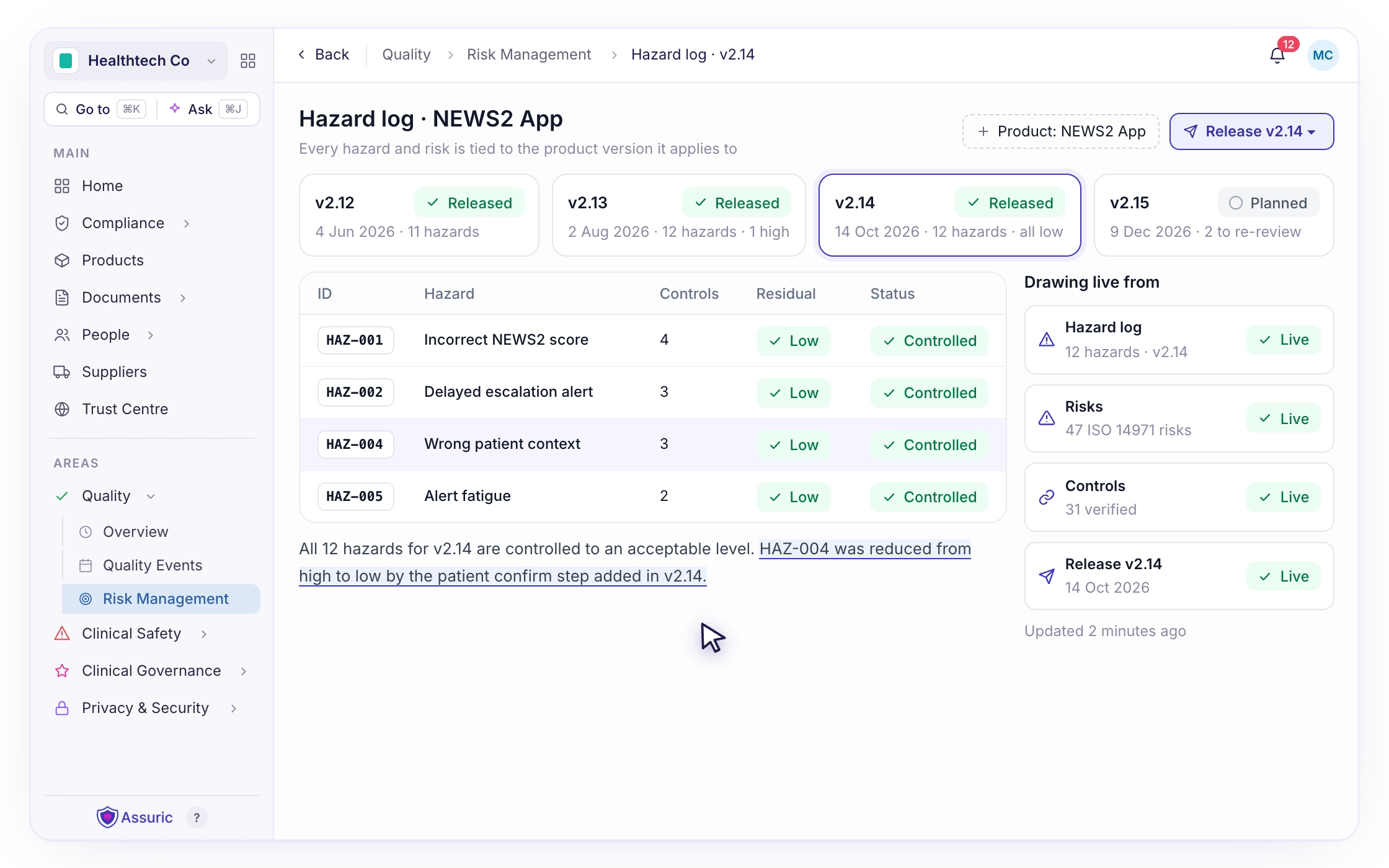
See which product version each risk relates to
Connect risks to the releases they affect and the controls that manage them, so you know exactly what needs reviewing before each release.
Risk analysis, evaluation and control, connected to your design records and your releases, so your risk file stays current as your product changes.
Trusted bymedical device teams


Features
Connect risks to the releases they affect and the controls that manage them, so you know exactly what needs reviewing before each release.
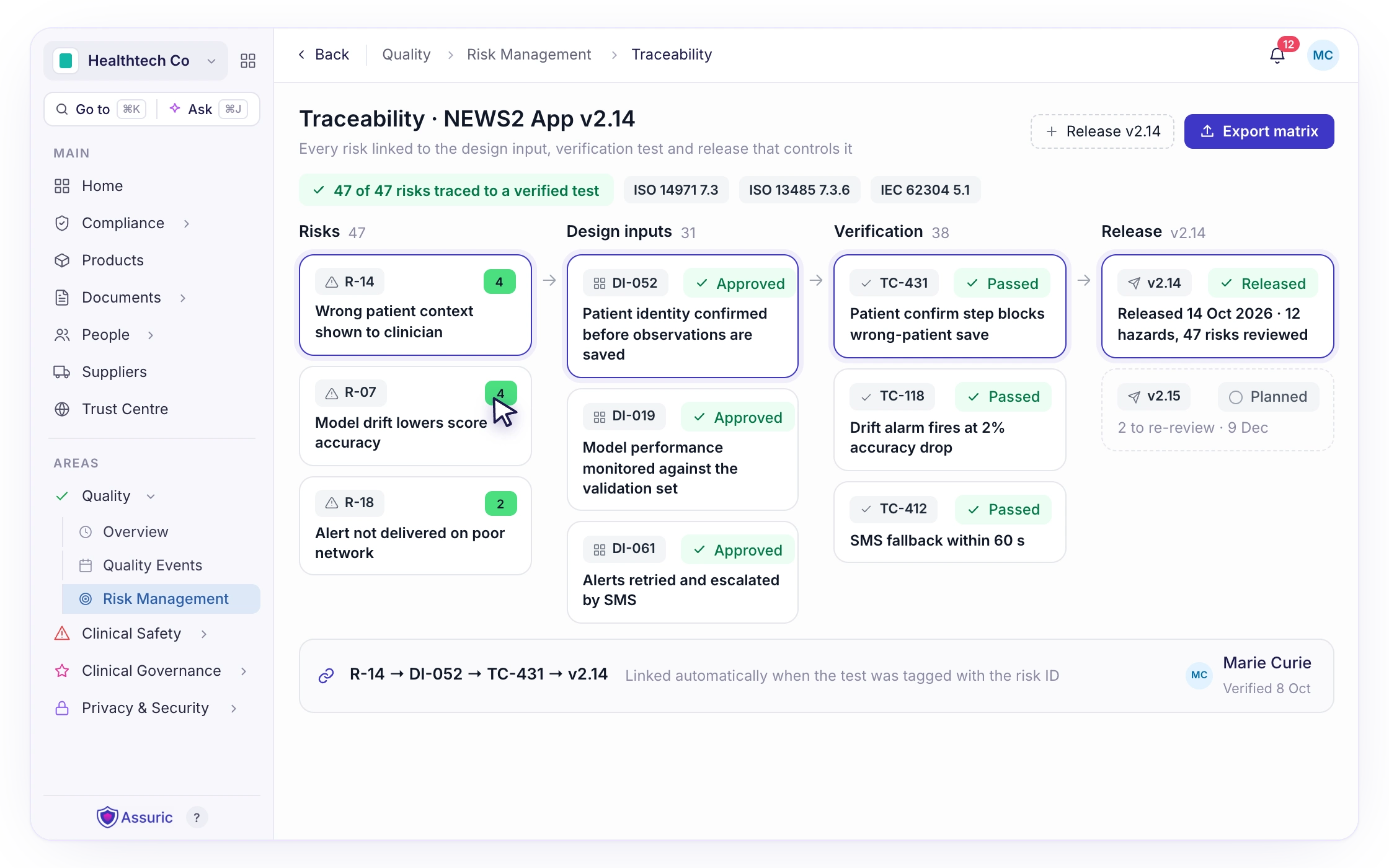
Follow each risk through its causes, controls, verification evidence and the release it affects, in either direction, and pull a traceability matrix in one click.
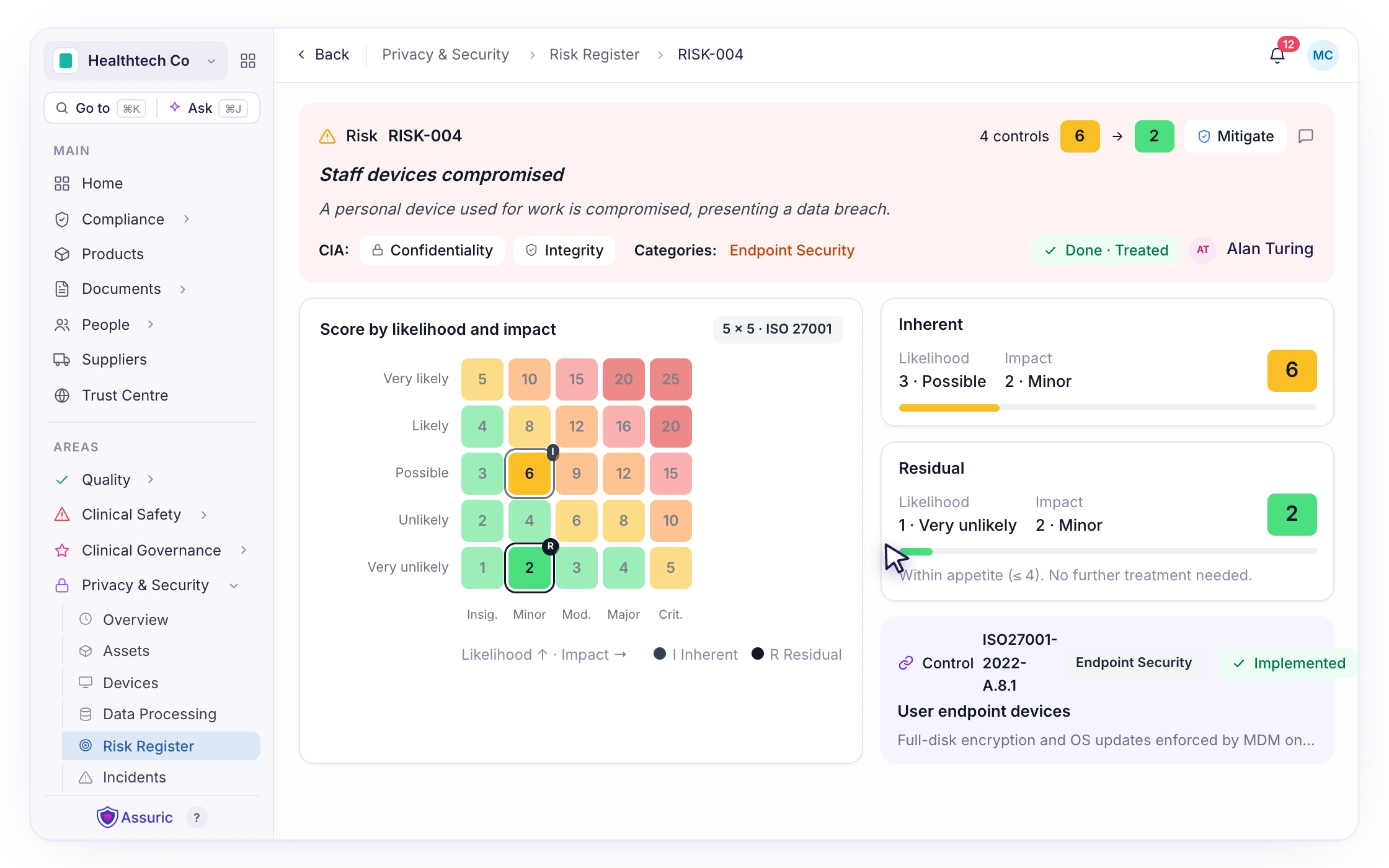
Set your own severity and probability scales, acceptability criteria and benefit-risk, run FMEAs, and use a different matrix for each product if you need to. Hazards and harms are coded with IMDRF terms.
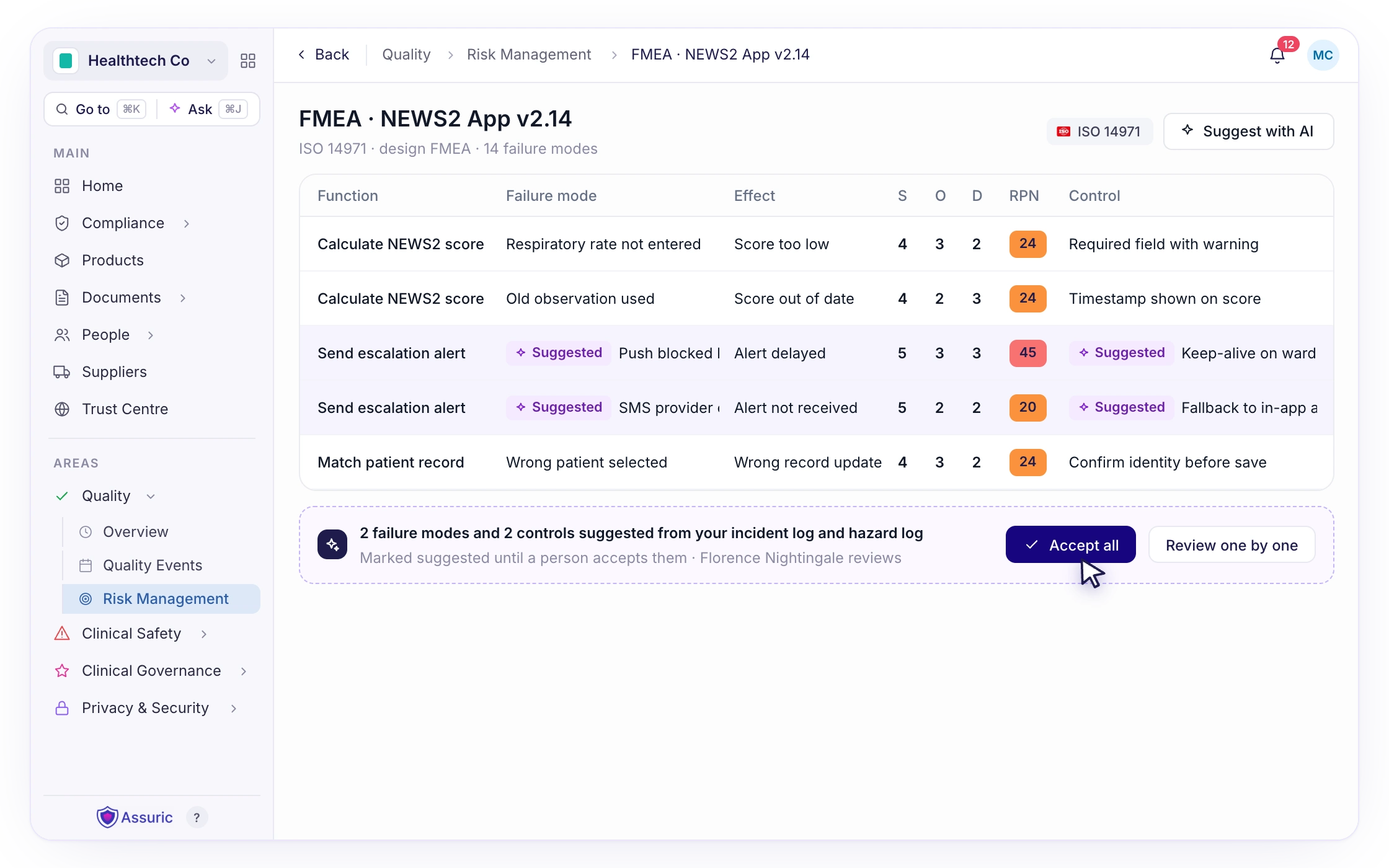
AI drafts risks, failure modes and controls from your design records and existing risk file, and finds controls with missing verification evidence. Every suggestion is a tracked change that a named person accepts.
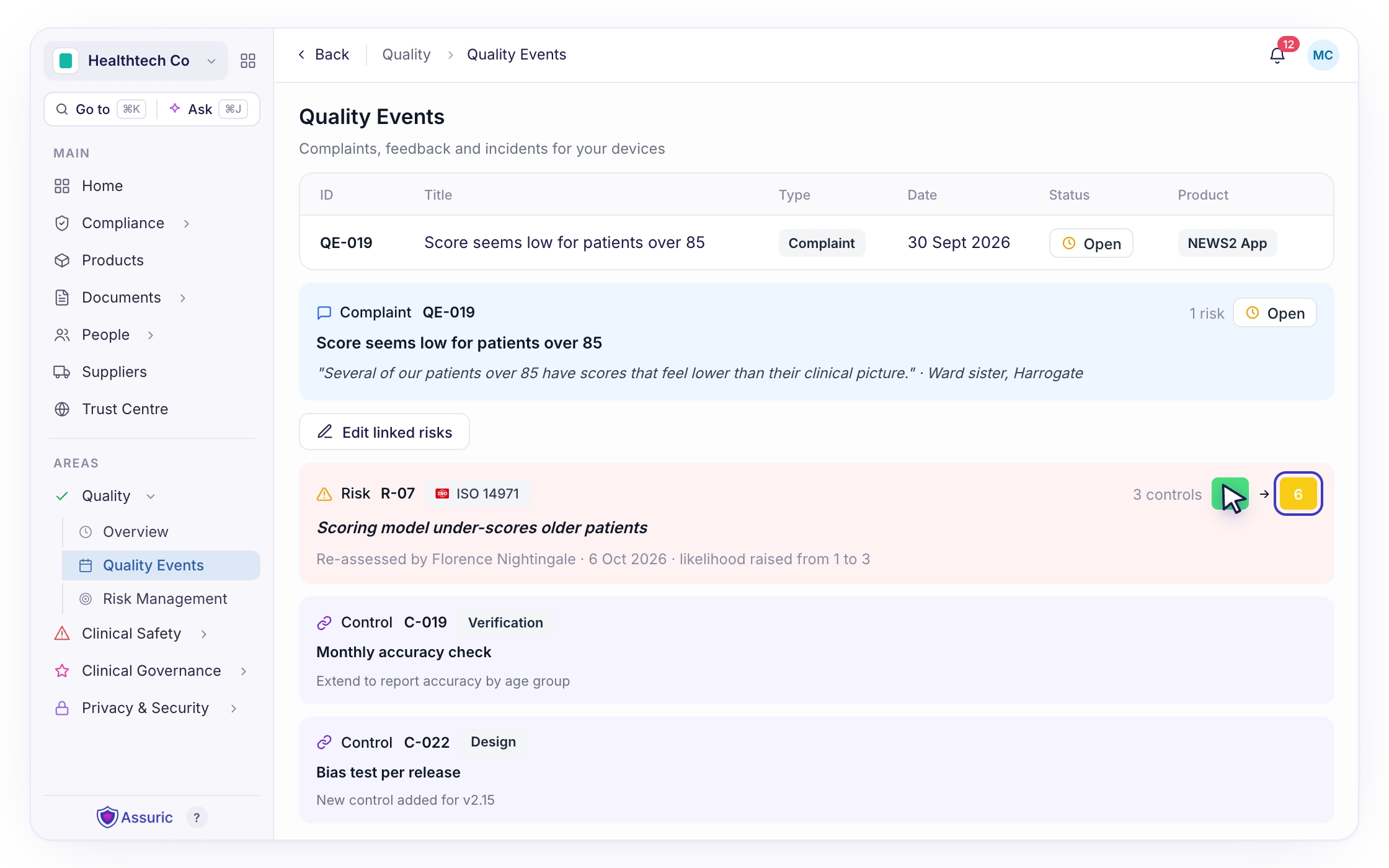
Complaints, incidents and post-market surveillance data link to the risks they affect and flag them for review, so your risk file stays live after launch.
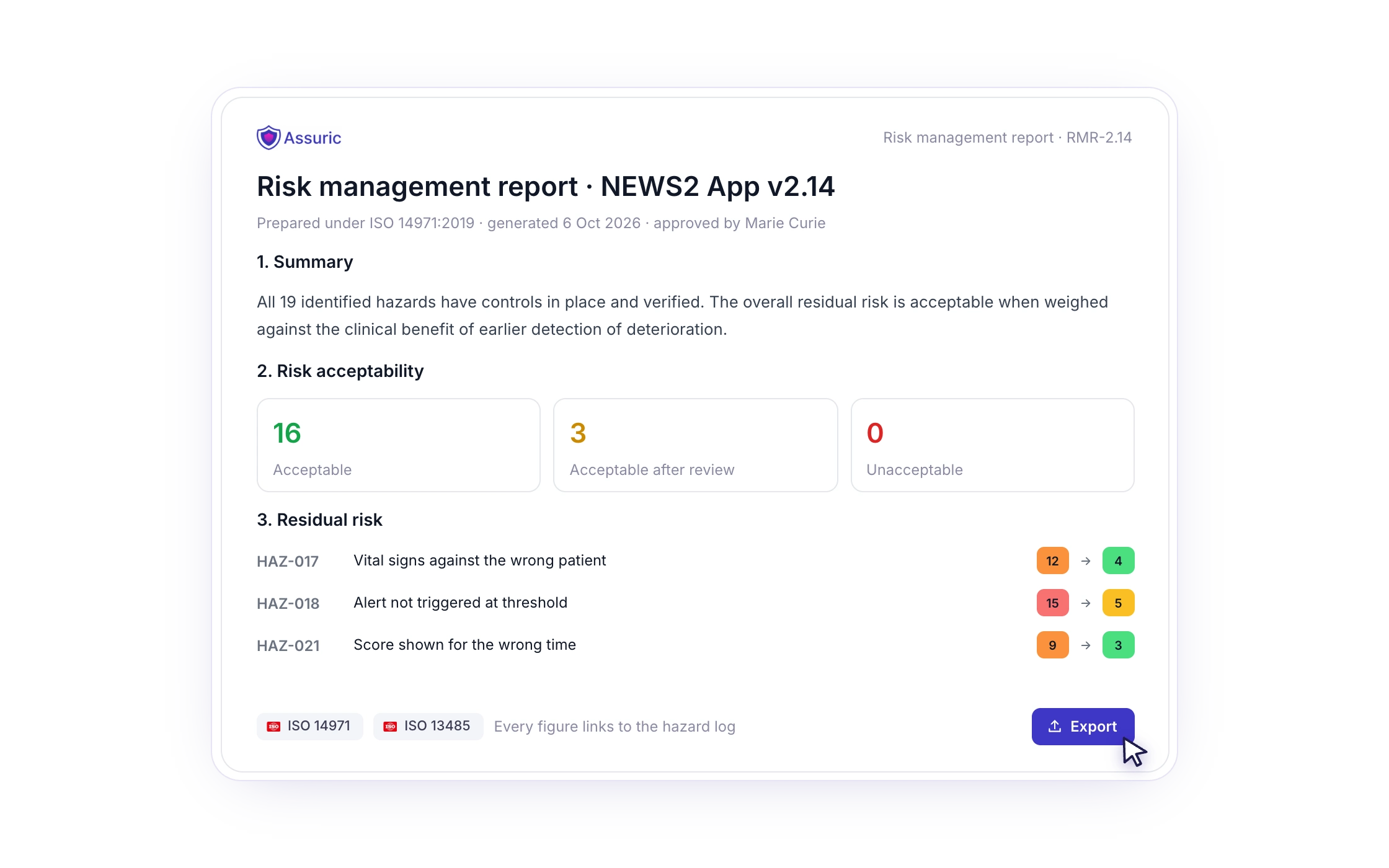
Generate your risk management file and report from live records, ready for an auditor or notified body, and regenerate them whenever something changes.
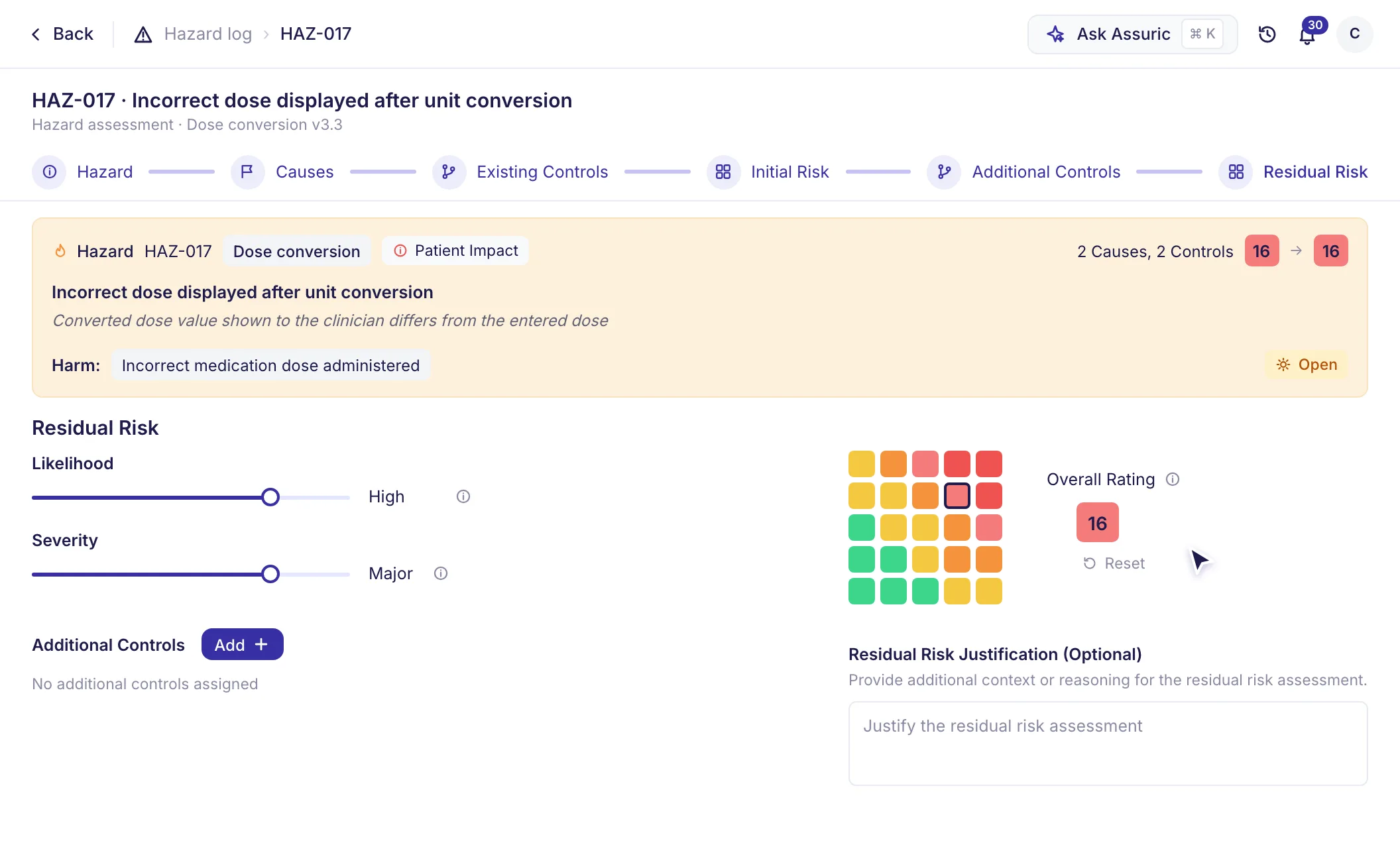
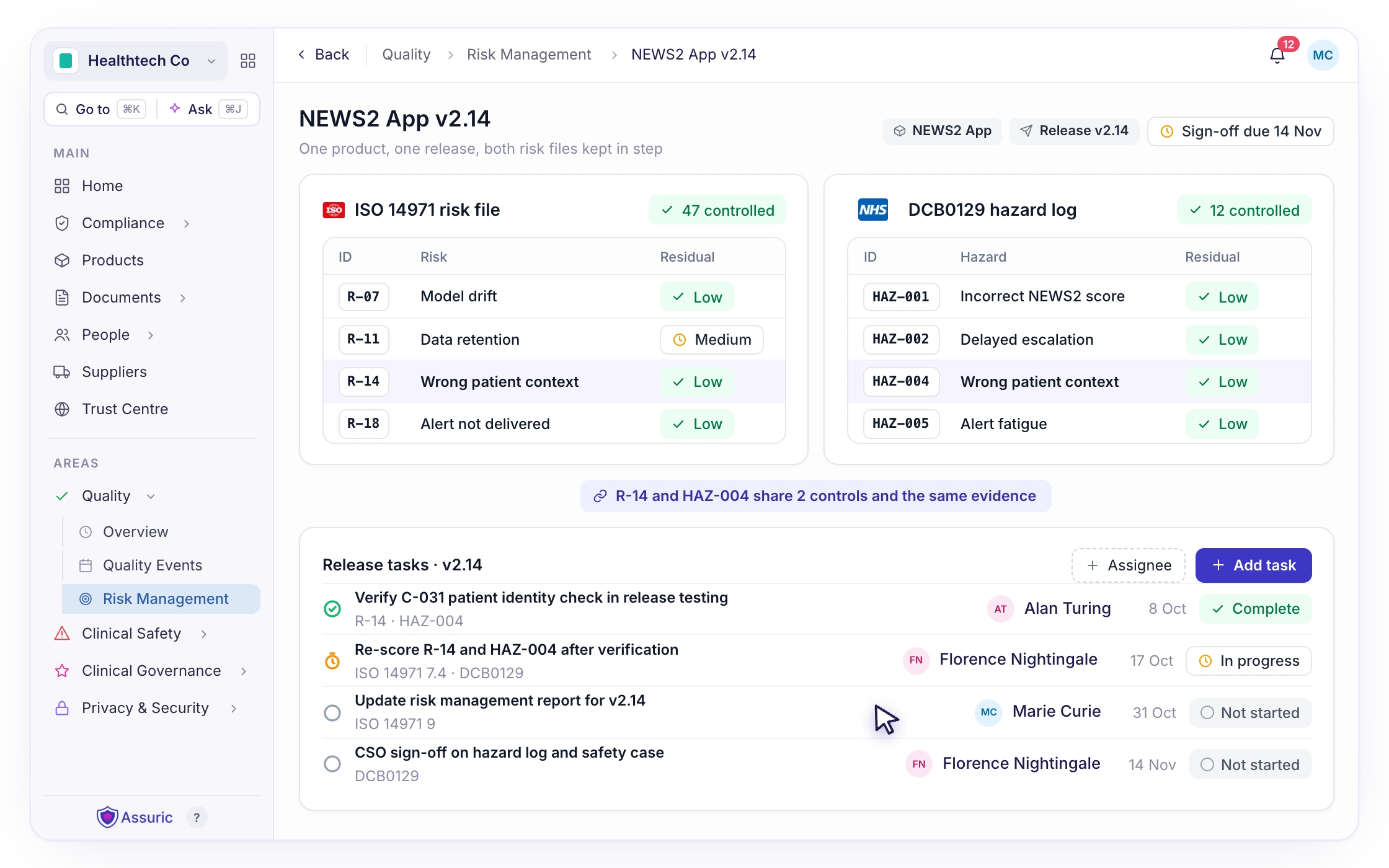
Keep your ISO 14971 risk file and DCB0129 hazard log side by side, linked to the same product and release records, with AI-specific risk controls managed inside your QMS.
Benefits

AI suggestions, linked records and generated reports take care of the repetitive work, so keeping your risk file current takes minutes, not a quarterly clean-up.
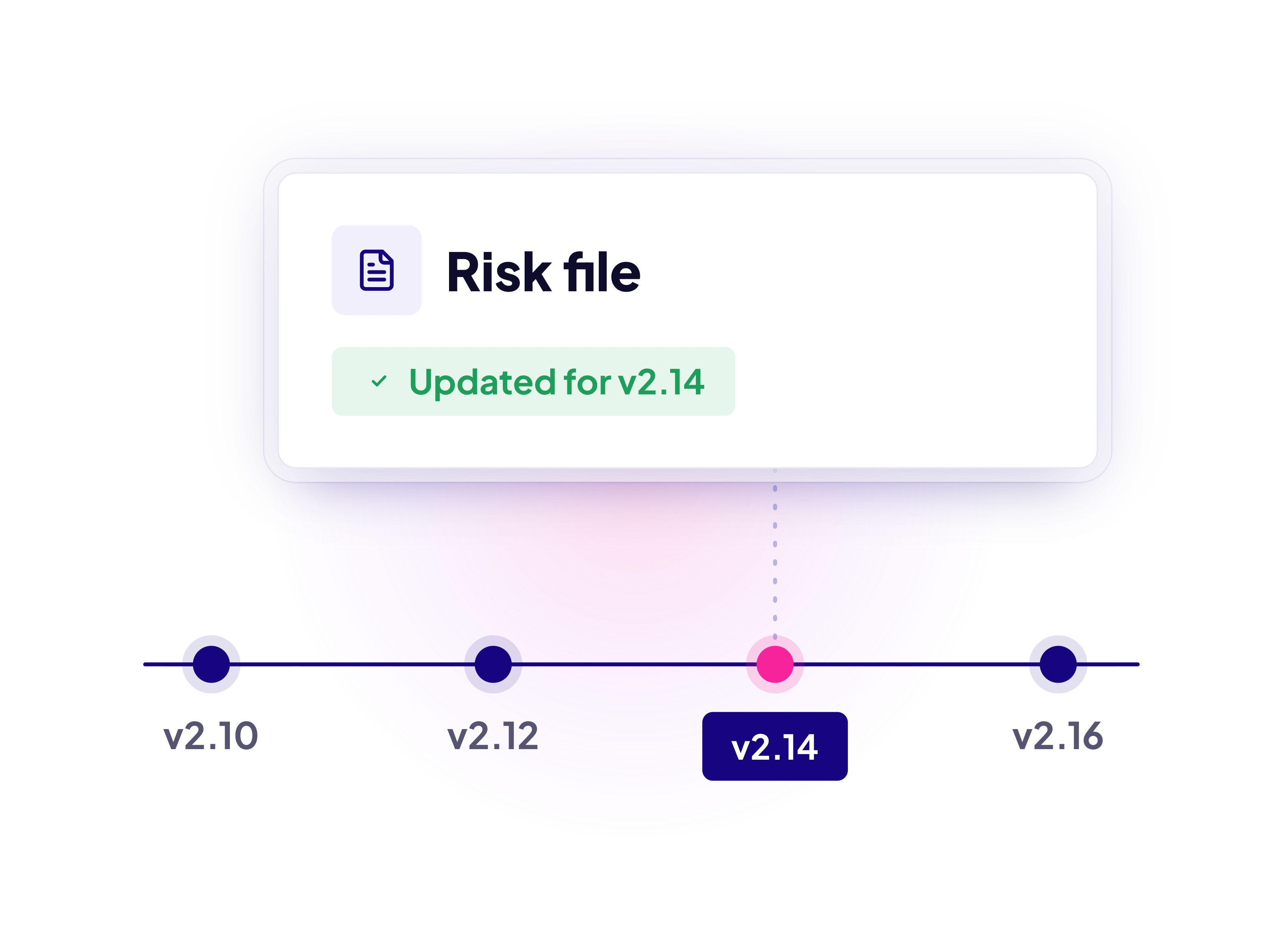
When your product changes, see which risks and controls need reassessing, so reviews focus on what’s actually changed.
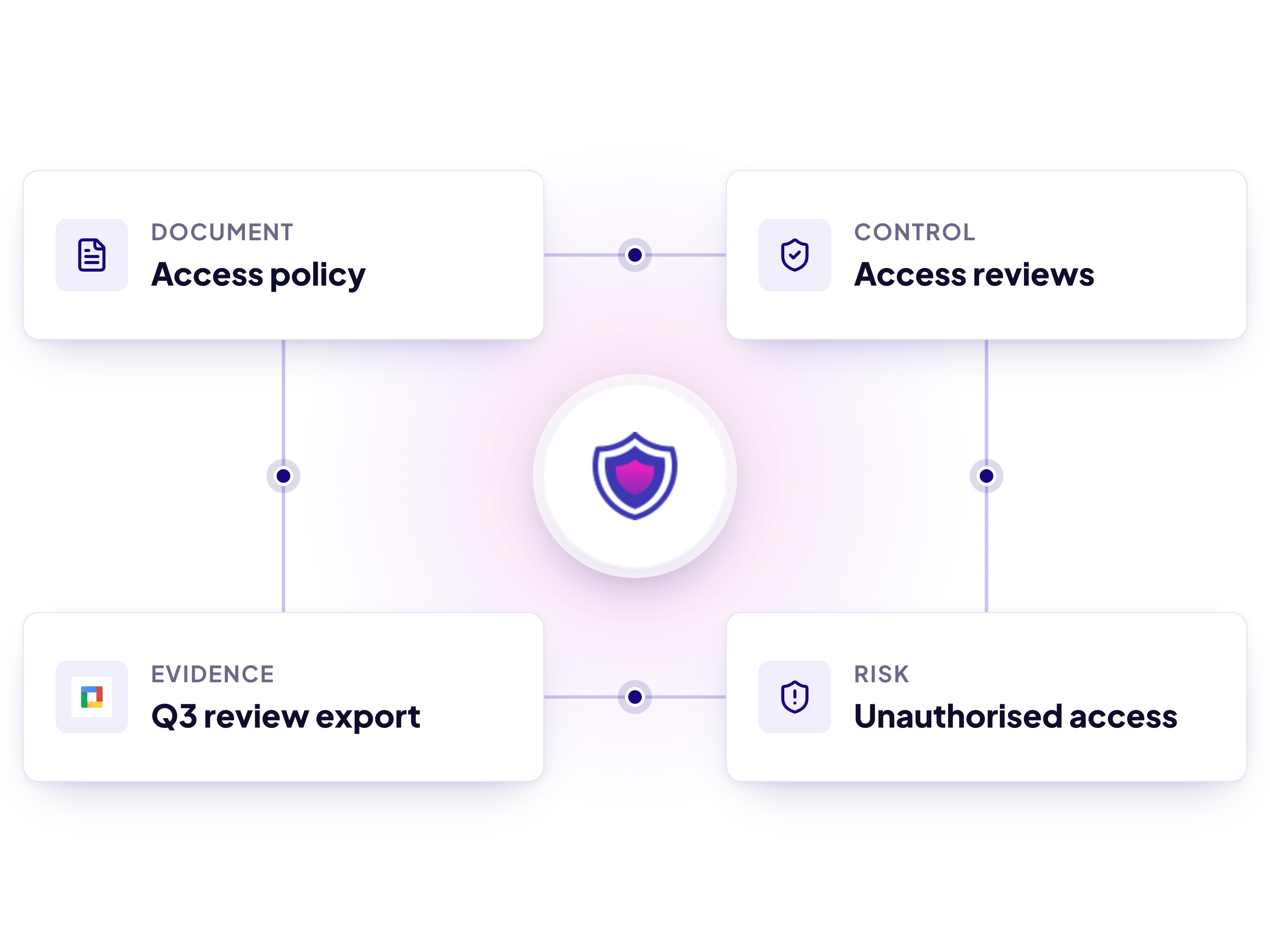
Risks, controls, evidence and releases stay linked, and your risk management report is always one click away, so audits are a review, not a scramble.
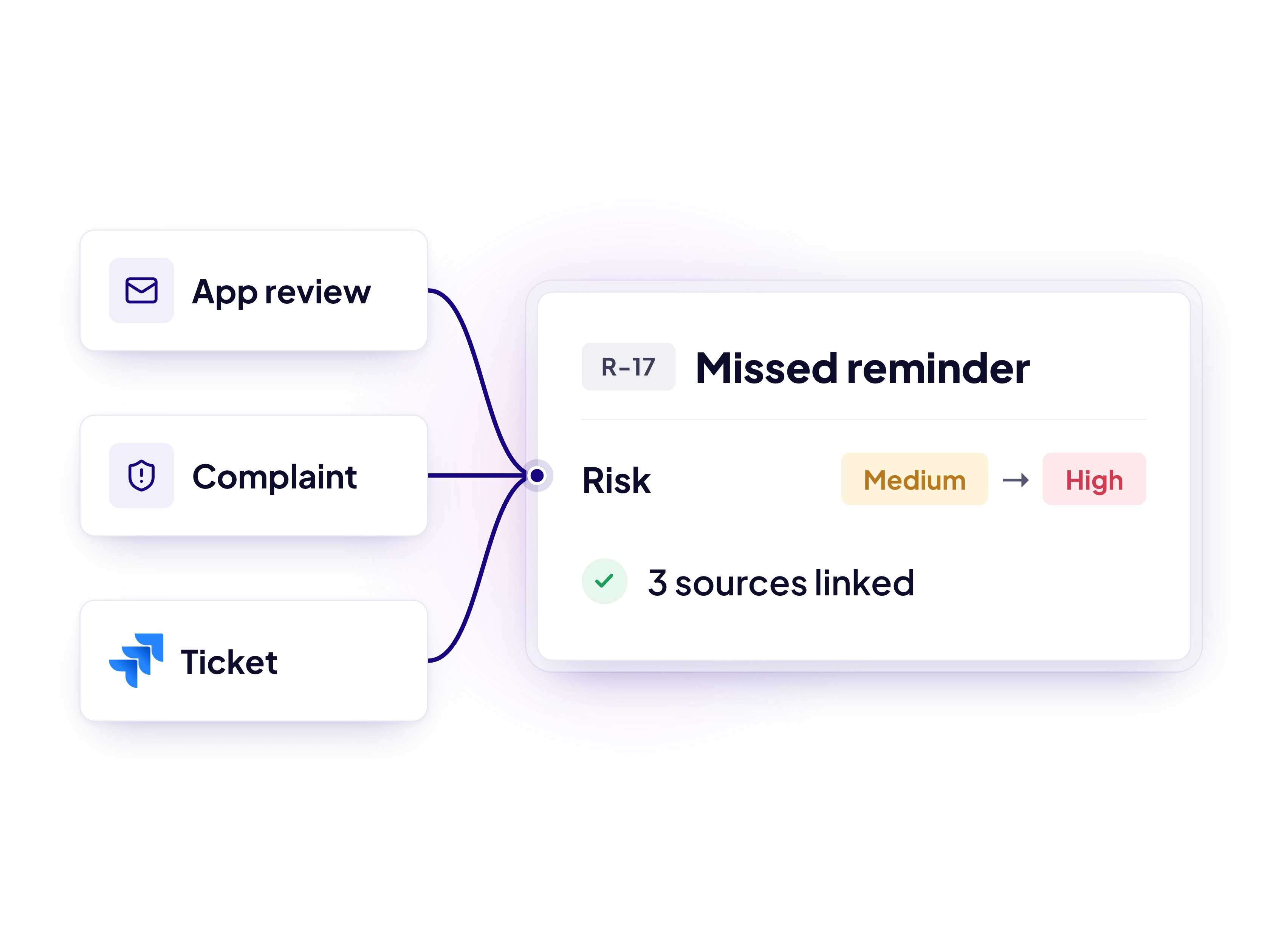
AI and post-market feedback surface new risks and gaps early, so you deal with them before an auditor or a patient does.

ISO 14971 device risk and DCB0129 clinical safety in one place, with full oversight across both.

“We couldn't speak highly enough of both the Assuric team and the platform itself, which is incredibly easy to use, and with the skill and hardworking nature of the Assuric team. They've been a key component in accelerating our progress and deployments!”
Maks Kozarzewski
COO, VitVio

“The Assuric platform is a game changer in the clinical risk management field. It has been carefully designed to make the job of a CSO significantly more streamlined. The team are excellent and responsive to any product suggestions I have requested, and it has been a pleasure to work with them.”
Paul Llewellyn
CCIO, Accenture

“Assuric has been fantastic in helping us quickly and safely navigate regulatory compliance in the UK. From completing Cybersecurity requirements to DSPT, DCB0129, and DTAC, the team was supportive, extremely knowledgeable, and the platform made everything quick and straightforward. A separate regulatory company we consulted at the beginning even remarked on how quickly we achieved compliance!”
Katie Baker
Director UK & Ireland, Tandem
Overlapping requirements and evidence are mapped across frameworks automatically, so you never do the same work twice.
The international standard for risk management of medical devices. It sets out a lifecycle process: identify hazards, estimate and evaluate the risks, control them, and monitor the effectiveness of those controls in production and post-production.
They overlap heavily. ISO 14971 is the medical device standard used for MHRA and EU MDR purposes, and DCB0129 is the NHS clinical risk management standard. Both ask you to identify hazards, control them and evidence it. Assuric holds both the ISO 14971 risk file and the DCB0129 hazard log.
Yes. Configure your own severity and probability scales and acceptability criteria, run FMEAs, and use a different matrix for each product or device class if you need to.
Yes. Hazards and harms can be coded with IMDRF terms, so your risk file uses the same language as regulators and your vigilance reporting.
Yes. Generate your risk management file and report from live records in a click, and regenerate them whenever something changes, ready for an auditor or notified body.
Complaints, incidents and post-market surveillance data link to the risks they affect and flag them for review, so your risk file reflects what you learn after launch.
Not under current UK and EU frameworks. There is no separate AI medical device regime to comply with: AI is managed within your existing ISO 13485 quality system through AI-specific policies, risk controls and change management. The EU AI Act adds obligations, but it does not replace the device framework.
Not strictly. The regulations require documented risk management for every device, but ISO 14971 is the recognised standard rather than a legal requirement, so at Class I you can use another recognised approach, such as DCB0129. From Class IIa upwards, notified and approved bodies expect ISO 14971 in practice. Building your risk file to ISO 14971 at Class I saves reconstructing it when you move up a class.
Whenever the product changes materially, whenever post-market data suggests a control is not working, and on a defined periodic cycle. Assuric holds the review dates and owners so the cycle is scheduled, and post-market data flags risks for review between cycles.
Talk to us about bringing your QMS, risk file, hazard log and releases together in one system.


